Which Industrial Printing Method Is Best for Durable Packaging?
Durable packaging is not created by a printing method alone. It results from the interaction of print technology, substrate, ink system, coating or varnish, curing process, converting operations, and the conditions the pack will face after it leaves the factory. A beautifully printed carton can still fail if its ink scuffs during case packing; a robust corrugated shipper can lose legibility if its print is applied to an unstable linerboard surface; a food package can meet abrasion targets but fail migration requirements because the full print-and-coating construction was not assessed.
For most packaging applications, the practical answer is clear: flexography is usually the strongest choice for high-volume corrugated and flexible packaging where durability and production efficiency matter most; offset lithography remains the reference method for premium carton graphics and precise brand-color reproduction; and digital printing is valuable where versioning, short runs, and fast changeovers outweigh its higher unit cost. Gravure still has a place in very long-run flexible packaging, while screen printing serves specialist applications requiring unusually heavy ink deposits or tactile effects.
The best industrial printing method is therefore the one that protects the required visual information throughout the package’s actual life cycle—not merely the one that produces the most impressive sample at press approval.
Start with the failure mode, not the press type
“Durability” can mean very different things depending on the package. A warehouse-ready corrugated box may need readable barcodes and graphics after pallet handling, conveyor contact, humidity changes, and last-mile delivery. A folding carton for cosmetics may need dense blacks, smooth gradients, metallic effects, and resistance to rub inside a tightly packed shipping case. A frozen-food pouch faces moisture, low temperatures, flexing, and potential contact with condensation. A chemical label may require resistance to oils, solvents, and outdoor exposure.
Before comparing printing processes, define what must remain intact:
- Brand colors, fine text, and barcode readability;
- Resistance to dry rub, wet rub, scratching, and scuffing;
- Adhesion to the selected paper, board, film, foil, or coated substrate;
- Resistance to moisture, grease, freezing, heat, or UV exposure;
- Compatibility with die-cutting, folding, gluing, lamination, heat sealing, and filling;
- Compliance with applicable food-contact, chemical, recycling, and labeling requirements.
This distinction matters because a process can be durable in one construction and unsuitable in another. For example, a water-based flexographic ink may perform very well on an absorbent corrugated liner, while an uncoated version of the same chemistry may have inadequate adhesion on a low-surface-energy plastic film. Similarly, offset ink protected by an appropriate aqueous coating or UV varnish can withstand substantial handling, but unprotected offset print on a carton surface may scuff during high-speed packing.
Flexography: the durable workhorse for corrugated and flexible packaging
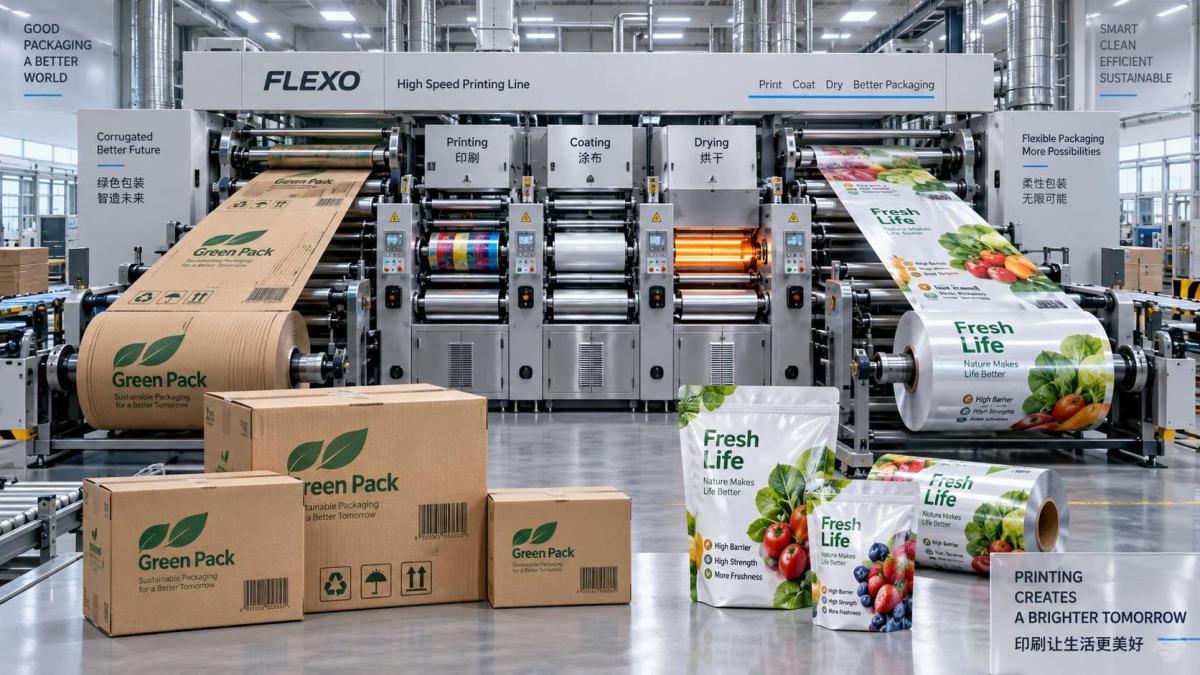
Flexographic printing transfers ink from an anilox roller to a flexible relief plate and then to the substrate. Its central advantage is adaptability. It can print on corrugated linerboard, paper bags, labels, polyethylene, polypropylene, polyester films, aluminum foil, and many laminated structures. It also integrates naturally with high-throughput packaging operations, including web converting and direct printing on corrugated board.
For shipping boxes, flexography is often the most rational choice. Direct-to-board flexo eliminates the need to print a separate sheet and then mount it onto corrugated board. That reduces material layers and can simplify production. Water-based inks are widely used for corrugated applications, where the absorbent paper surface supports drying and where high-gloss photographic reproduction is not always the main requirement.
Modern flexographic systems can produce clean linework, solid coverage, and increasingly capable tonal reproduction, particularly with well-controlled plates, anilox selection, ink viscosity, drying, and substrate consistency. But flexo’s real value in durable packaging lies in operational resilience: it handles large repeat volumes efficiently and can be engineered around the packaging line rather than treated as an isolated graphics process.
Its limitations should be assessed honestly. Fine halftones, subtle vignettes, and highly critical brand colors can be more difficult on rough, absorbent corrugated surfaces than on coated paperboard. Corrugated flute profile, linerboard smoothness, board caliper variation, and compression at the print nip can all affect print uniformity. High-quality preprint flexo or litho-lamination may be preferable when a corrugated pack must carry premium retail graphics as well as transit protection.
For films and non-absorbent substrates, the ink system and surface preparation become decisive. Corona treatment, flame treatment, primers, or specialized ink formulations may be necessary to secure adhesion. Inadequate treatment can produce a package that looks acceptable when printed but fails tape, rub, or flex testing later in distribution.
Offset lithography: best when visual durability includes precision
Offset lithography remains a leading method for folding cartons, pharmaceutical cartons, beverage multipacks, premium consumer goods packaging, and litho-laminated corrugated displays. It is especially strong where packaging depends on fine typography, image detail, smooth tonal transitions, stable process-color reproduction, and accurate registration between multiple colors, varnishes, or special effects.
The basic process prints from a plate to a rubber blanket and then onto the sheet. This indirect transfer produces excellent detail on smooth paper and paperboard grades. Where a package is expected to communicate luxury, technical credibility, or strict brand consistency, offset often offers the most dependable visual platform.
However, offset print by itself should not be equated with durable packaging. Conventional oil-based inks may require sufficient drying and curing time before aggressive converting or packing. If sheets are die-cut, creased, folded, and glued before the ink film has developed adequate resistance, scuffing and set-off can appear. Set-off occurs when freshly printed surfaces transfer ink or varnish onto the reverse side of adjacent stacked sheets.
Protective coatings are therefore part of the decision, not an afterthought. Aqueous coatings can improve rub resistance and provide a practical protective layer for many cartons. UV-cured varnishes can offer stronger surface resistance, gloss, or matte effects, although their suitability must be evaluated against downstream processes and end-use requirements. Heavy coatings may crack on sharp creases, interfere with gluing, or complicate repulping and recycling routes depending on the total package structure.
For corrugated packaging requiring premium graphics, litho-lamination combines offset-printed liner sheets with corrugated board. The result can be visually superior to direct flexo on board, but it introduces additional materials, bonding steps, and alignment controls. It is justified when retail presentation is commercially important enough to support the added process complexity.
Digital printing: durable when agility is the governing requirement
Digital packaging printing is not one technology. It includes electrophotographic toner systems and inkjet systems using water-based, UV-curable, latex, or other proprietary ink chemistries. Its defining operational feature is the absence of conventional printing plates. That reduces setup work and makes variable data, localized artwork, seasonal versions, and short production runs economically more feasible than with plate-based processes.
Digital is often the best answer when the packaging program has many stock-keeping units, frequent artwork changes, controlled-volume launches, or versioned labeling. It can also reduce the commercial risk of holding large inventories of obsolete printed packaging.
Durability must be validated at the system level. Inkjet ink chemistry, substrate coating, primer, curing energy, and surface tension all influence adhesion and rub performance. UV inkjet can create a tough surface on suitable substrates, but the cured ink film may have limitations in flexibility on highly deformable films or at severe fold lines. Water-based inkjet can provide excellent graphic quality, but it may require treated or coated substrates and carefully designed drying capacity. Toner-based print can be highly robust in some carton and label applications, yet its performance through creasing, folding, and heat exposure should be tested rather than assumed.
Digital printing also changes the quality-control challenge. With conventional printing, process stability is often managed through plates, ink keys, and repeatable press conditions. In digital systems, nozzle health, curing consistency, color management, substrate qualification, and software workflow can be equally critical. A durable digital package requires controlled production conditions, not simply a capable press.
Gravure and screen printing: specialist answers, not default choices
Gravure printing uses engraved cylinders to transfer ink and is particularly associated with long-run flexible packaging, decorative films, and high-volume work requiring consistent reproduction over very large quantities. The engraved cylinder can deliver strong ink laydown and high-quality images on films and other web substrates. Once cylinder cost is justified by run length, gravure can be highly effective.
Its principal constraint is economic and operational rather than visual. Engraved cylinders require time and capital to prepare, making gravure poorly suited to frequent artwork changes or modest order sizes. For durable flexible packaging, it remains a credible choice where long-run consistency, high-quality graphics, and established converting infrastructure align.
Screen printing applies a much thicker ink layer than most mainstream package-printing processes. This can be useful for opaque whites, tactile varnishes, raised effects, conductive inks, and high-opacity printing on dark or difficult substrates. It is not normally the first choice for mainstream high-volume cartons or shipping cases, but it can solve specific durability and visibility problems that thinner ink films cannot.
Ink and coating selection often determines the real outcome
A common sourcing error is to compare press technologies without specifying the ink, coating, and substrate construction. The same flexographic press can print with water-based, solvent-based, UV-curable, or electron-beam-curable systems, each with different drying behavior, adhesion characteristics, odor profiles, and resistance properties. The same applies to offset and digital systems.
Water-based inks are frequently used on paper and corrugated substrates. Solvent-based systems have long been used on flexible films because they can support wetting and adhesion on non-absorbent surfaces, but solvent handling, emissions control, and residual-solvent management require disciplined process control. UV and EB curing can provide rapid cure and strong surface properties, although material compatibility, migration assessment, and curing completeness are essential considerations for sensitive applications.
Where packaging contacts food directly or indirectly, printing inks are not assessed only by visible quality. The full packaging structure matters: printed side, reverse side, functional barriers, set-off potential, printing coverage, curing conditions, storage time, and intended food use. In the European Union, printed food-contact packaging is commonly assessed within the framework of Regulation (EC) No 1935/2004 on materials and articles intended to come into contact with food, together with applicable national measures and Good Manufacturing Practice requirements under Regulation (EC) No 2023/2006. In the United States, food-contact compliance is evaluated under the applicable FDA regulatory framework for the materials and intended conditions of use. These frameworks do not eliminate the need for product-specific assessment.
Test the converted package, not just the printed sheet
A press-side sample cannot fully predict distribution performance. The relevant test point is the finished pack after printing, coating, die-cutting, folding, gluing, filling, packing, and—where applicable—lamination or heat sealing. Crease lines can fracture ink and varnish. Adhesives can be inhibited by coatings. Gloss surfaces can show scuffs more visibly than matte surfaces even when measured abrasion resistance is similar. Dark solids and metallic finishes often reveal damage earlier than lighter graphics.
Testing should reflect the actual risk. Rub and abrasion testing may be relevant for cartons subject to case packing. Adhesion tests can identify poor bonding on films and coated stocks. Fold and crease evaluations expose cracking. Barcode verification should be performed on production material, particularly where print gain, board texture, or variable-data printing could compromise scan performance. For cold-chain, outdoor, chemical, or high-humidity use, conditioning at relevant temperatures and exposure conditions is more meaningful than a standard room-temperature inspection.
Durability also has a supply-chain dimension. A packaging specification that relies on a narrowly defined coating, substrate treatment level, or curing window can become fragile if alternate suppliers cannot reproduce it. Specifications should identify performance requirements—such as acceptable rub resistance, color tolerance, adhesion, and barcode grade—while leaving room for validated equivalent materials where continuity matters.
A practical selection logic
Choose flexography when the package is primarily a corrugated shipper, paper-based transport pack, or high-volume flexible structure and the key requirement is efficient, repeatable output with reliable functional graphics. Move toward preprint flexo or litho-lamination when corrugated packaging must also perform as a high-impact retail display.
Choose offset lithography when visual precision, fine detail, and brand presentation are central to the package, especially for folding cartons and premium paperboard applications. Treat coating selection, drying or curing, crease behavior, and glue areas as part of the printing specification from the beginning.
Choose digital printing when the commercial cost of plate changes, inventory obsolescence, or multiple versions exceeds the higher per-unit cost of digital output. Require evidence that the chosen digital ink and substrate combination survives the actual converting and distribution cycle.
Choose gravure when run lengths are sufficiently long to justify cylinder preparation and the flexible-packaging structure demands high, stable reproduction over extensive production volumes. Use screen printing where opacity, texture, specialty functionality, or heavy ink laydown is the real requirement.
The strongest packaging programs do not ask which process is universally best. They ask which print construction will remain legible, attractive, compliant, and manufacturable after every stress the specific package is designed to endure. That is the point at which industrial printing becomes a packaging-performance decision rather than a graphics decision.
Related News
Get weekly intelligence in your inbox.
No noise. No sponsored content. Pure intelligence.
