
Where Digital Packaging Delivers the Most Value in Retail Campaigns
For business evaluators, digital packaging for retail earns its place when it solves a campaign problem that conventional production handles poorly: a launch window is short, artwork is still evolving, regional offers must differ, or a brand needs to learn before committing to a large print run. The value is not simply “printing digitally.” It is the ability to connect retail marketing decisions with production decisions—without letting minimum order quantities, long plate lead times, or static SKU plans dictate the campaign.
In a crowded aisle, packaging has only a few seconds to communicate price tier, product relevance, seasonal mood, and brand trust. Online, the same pack may become the first physical touchpoint after a customer opens a parcel. Retail teams therefore need formats that can move quickly from idea to shelf, remain visually consistent across channels, and still make economic sense at the required volume.
The highest-value applications tend to appear where variation is meaningful, time matters, and the operational cost of being wrong is high.
Retail value begins with the campaign decision, not the print method
A useful evaluation starts with a simple question: What must change, and why? If a campaign uses one design for millions of identical cartons over a long period, a conventional offset workflow may remain the logical production choice. Modern offset presses offer exceptional throughput, stable color control, and attractive unit economics at scale. But retail campaigns are rarely that static.
They may require a limited-edition cosmetic carton for a holiday set, multiple language versions for a cross-border launch, a retailer-exclusive snack box, or a direct-to-consumer shipper featuring a loyalty message. In these situations, the economics shift. The relevant comparison is no longer only cost per printed sheet. It includes artwork setup, inventory exposure, obsolescence risk, campaign responsiveness, fulfillment complexity, and the cost of missing a retail window.
Digital packaging for retail is most compelling when it reduces the total cost of campaign change. That does not mean every component must be digital. Often, the strongest model is hybrid: digitally produced short runs and versions alongside offset-produced core volume, with automated converting and quality control maintaining a common pack standard.
1. Seasonal, event-led, and retailer-exclusive packaging
Seasonal retail remains one of the clearest applications. A Valentine’s gift sleeve, back-to-school promotion, Lunar New Year carton, sports-event display pack, or limited summer flavor may only be relevant for a narrow sales period. Ordering too much can leave a brand with dated inventory. Ordering too little can create stock gaps when consumer response is stronger than expected.
Digital workflows support smaller, more closely timed batches. Marketing can hold final messaging longer, react to licensed artwork approvals, or add a retailer-specific callout without rebuilding an entire conventional setup. This is particularly useful when a national campaign is adapted for several retail chains, each with its own promotional language, shelf format, or bundle configuration.
For evaluators, the important measure is not whether a short run costs more per unit. It is whether the campaign avoids write-offs, markdowns, emergency freight, and missed selling days. A premium unit cost can be rational when it protects a high-margin event or enables a campaign that would otherwise be too risky to launch.
2. SKU proliferation without packaging chaos
Retail portfolios have become more fragmented: smaller sizes, subscription editions, dietary claims, regional formulas, private-label variants, bundles, and channel-specific assortments all create SKU pressure. Packaging teams can quickly find themselves managing a library of nearly identical files, each carrying different legal text, barcodes, languages, or promotional offers.
Here, digital packaging creates value through controlled variation. Variable-data capabilities can change selected content while preserving approved brand elements. A campaign may retain the same visual architecture—logo position, key color, typography, compliance panel—while updating market language, QR codes, store group identifiers, or serial information.
This is not merely a design advantage. It can simplify inventory planning by allowing late-stage differentiation. Instead of holding separate preprinted packaging for every market well in advance, a business may maintain a more flexible production plan and release versions closer to actual demand. That approach requires disciplined data governance, however. A single incorrect barcode or untranslated mandatory statement can turn flexibility into a costly recall risk.
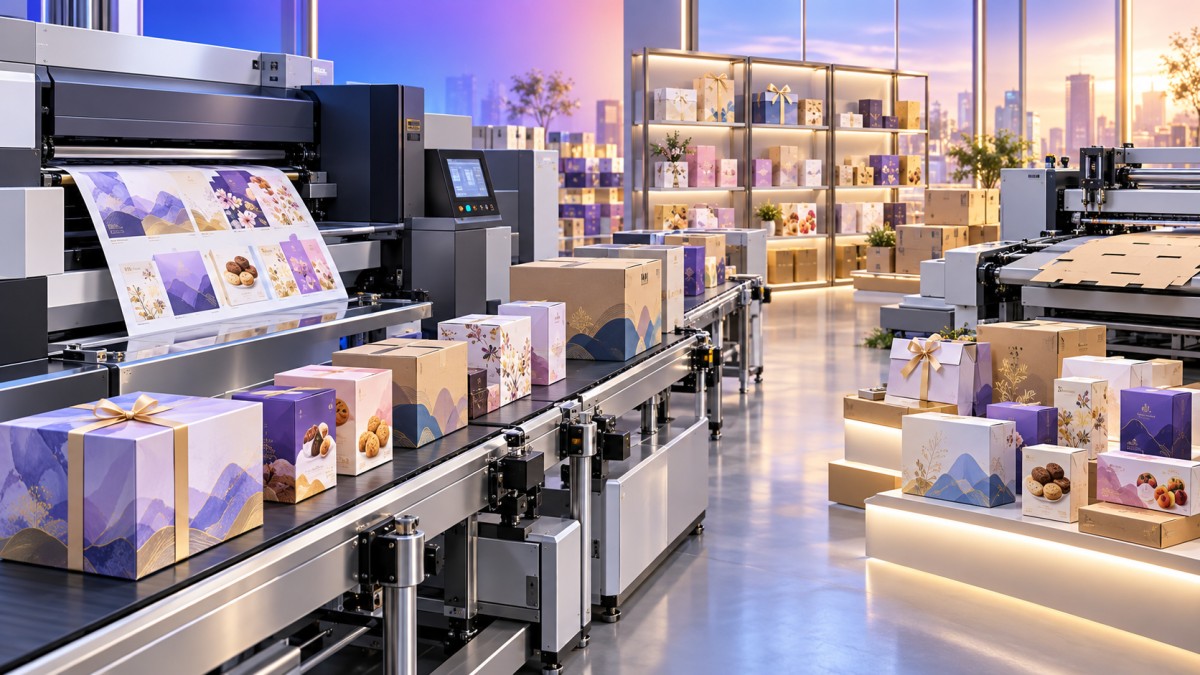
The control point is artwork governance
Variable retail packaging should be managed as a controlled system, not as an open-ended creative exercise. Approved templates, locked brand zones, version naming rules, and automated preflight checks are essential. The best digital workflow does not invite uncontrolled variation; it makes permitted variation faster and safer.
Business evaluators should ask whether the production environment can validate version-specific content before output, track which files were printed, and connect those records to batch, finishing, and delivery information. These capabilities matter especially in food, cosmetics, healthcare-adjacent products, and regulated consumer goods, where artwork accuracy is inseparable from commercial risk.
3. Localized campaigns that still look like one brand
Localization is often discussed as translation, but retail packaging has more to carry than words. A local campaign may need different imagery, retail partner offers, cultural references, legal panels, units of measure, or product-use instructions. The challenge is to make those local choices feel intentional rather than improvised.
Digital printing supports localized artwork without forcing brands into excessively large minimum runs. A beverage producer can test city-oriented packs. A beauty brand can adapt gift cartons for regional preferences. A consumer electronics company can produce launch kits with market-specific inserts and multilingual outer packaging. The physical pack becomes closer to the retail moment it serves.
Color management deserves particular attention. A brand color that appears consistent on screen may shift noticeably across substrates, inks, finishing methods, and production conditions. For packaging, color is not a cosmetic afterthought; it affects shelf recognition and the perceived quality of the product inside. Campaign evaluators should look for a workflow that links digital color targets, substrate profiles, proofing procedures, and press-side verification. When digital and offset production coexist, the ability to align output across processes becomes a practical requirement.
4. Product launches, market tests, and controlled learning
Not every retail concept deserves a full-volume commitment on day one. New flavors, premium extensions, reformulated products, and unfamiliar markets carry uncertainty. Traditionally, packaging minimums can force a business to make a large inventory decision before demand is proven.
Digital packaging for retail enables a more measured path. A brand can release limited quantities in selected stores, gather sell-through feedback, refine claims or artwork, and expand only after the commercial proposition is clearer. This does not replace sound market research, nor does it make a weak product viable. It does reduce the physical barrier between a credible hypothesis and an informed decision.
For a business evaluator, the question is whether the workflow supports a repeatable test-and-scale model. Can artwork be revised quickly? Can test batches be matched to retail locations? Can the final high-volume specification transition efficiently to offset printing, die-cutting, and folder-gluing without altering the shopper experience? If the answer is no, the pilot may create more complexity than insight.
5. E-commerce-ready packaging with a retail identity
Retail campaigns increasingly cross the boundary between store shelves and home delivery. A launch may begin with social commerce, continue through a marketplace listing, and end with a parcel on a customer’s doorstep. The outer pack must protect the product, but it can also reinforce the campaign: a clean unboxing message, a replenishment prompt, a scannable product guide, or an invitation to register a purchase.
For short-run direct-to-consumer promotions, digital print can make exterior and interior messaging more responsive. It is well suited to product bundles, influencer mailers, subscription kits, replenishment programs, and event-driven e-commerce shippers. Yet attractive graphics should never distract from the physical requirements of transit packaging.
Corrugated board selection, flute profile, compression strength, adhesive performance, and die-cut accuracy still determine whether a shipper survives its journey. The strongest applications bring graphics and structural design together early. A box that looks distinctive but wastes board area, slows packing, or fails under stacking pressure is not delivering campaign value.
6. Premium short runs where finishing defines the experience
Luxury and premium retail categories often need modest volumes with a high expectation of detail. Fragrance discovery sets, boutique confectionery, special-edition spirits, high-value electronics accessories, and presentation boxes may rely on tactile cues as much as printed imagery.
Digital print can provide the agility for versioned artwork, but the final impression is shaped by converting. Precise die-cutting determines clean edges and reliable folds. Folder-gluers turn flat printed sheets into cartons that must erect correctly on packing lines. Foil, embossing, coatings, windows, and specialty substrates can add distinction, but each process introduces registration and handling considerations.
This is why evaluating a digital packaging application in isolation is misleading. The relevant production chain includes prepress, printing, drying or curing, inspection, die-cutting, creasing, folding, gluing, packing, and logistics. A beautiful printed sheet has little commercial value if downstream converting creates cracked folds, glue failures, or inconsistent carton geometry.
How to judge whether the application is genuinely high value
A practical business case should consider four forms of value together:
- Speed value: Can the brand enter a retail window, respond to a demand signal, or finalize campaign content later?
- Variation value: Are regional versions, retailer editions, personalized elements, or smaller SKU batches commercially meaningful?
- Inventory value: Will shorter, better-timed runs reduce obsolete packaging, storage needs, and end-of-season waste?
- experience value: Does the pack improve shelf navigation, campaign relevance, unboxing, or premium perception in a way consumers can notice?
If none of these values is material, digital may be an unnecessary complication. If two or more are substantial, it deserves serious consideration.
Common evaluation mistakes
The first mistake is treating digital output as automatically suitable for every substrate and every finishing requirement. Material compatibility, ink behavior, food-contact or migration requirements, rub resistance, and downstream glue performance must be verified for the intended application.
The second is measuring only press speed. A campaign’s actual lead time includes approval cycles, file preparation, substrate availability, color sign-off, conversion capacity, inspection, and distribution. Bottlenecks often sit after printing, especially when intricate die-cuts or complex carton folds are involved.
Another frequent error is overlooking data and automation. The more versions a campaign includes, the less viable manual file handling becomes. A connected workflow—linking approved artwork, production scheduling, inspection data, and manufacturing execution systems—can prevent small versioning errors from multiplying across the operation.
Finally, do not confuse sustainability with simply producing fewer units. Reduced obsolescence is valuable, but the full assessment should also consider board yield, trim waste, ink and coating choices, transport patterns, recyclability, and whether packaging dimensions are appropriate for both shelves and shipment.
Building a retail packaging model that can scale
The most resilient approach is rarely a choice between digital and conventional production. It is a manufacturing architecture that assigns each method to the work it performs best. Digital systems can handle launches, tests, localized versions, and time-sensitive campaign waves. High-speed offset presses can carry stable core volume. Automated die-cutters and folder-gluers can provide repeatable carton geometry across both streams, while corrugated board lines support the protective formats required by e-commerce distribution.
For business evaluators, this creates a more useful investment conversation. Rather than asking, “Should we digitize packaging?” ask where change enters the retail campaign, how often it occurs, and what it costs today. The answer will identify the points where digital packaging for retail delivers its greatest return: not as a novelty, but as a controlled capability for making timely, relevant, and manufacturable packaging decisions.
Related News
Get weekly intelligence in your inbox.
No noise. No sponsored content. Pure intelligence.
